

Most people assume vitamin D deficiency has one simple explanation: not enough sun. That belief is only half true, and it’s the reason so many people get their blood test back, see a low number, spend more time outdoors for a few weeks, and then wonder why their next report looks almost identical.
Deficiency is rarely caused by one factor in isolation.
It usually sits at the intersection of two or three things happening together, and until you identify which ones apply to you, sunlight alone won’t fix it.
This article goes past the basic “get more sun” advice and looks at what actually drives deficiency, how it’s properly diagnosed, and what the research says happens inside your body when it goes uncorrected for years rather than months.
Why “Just Sit in the Sun” Doesn’t Work for Everyone
Sun exposure is genuinely the biggest natural source of vitamin D, but several everyday and medical factors quietly reduce how much your body actually converts and uses, even when your sun exposure looks adequate on paper.
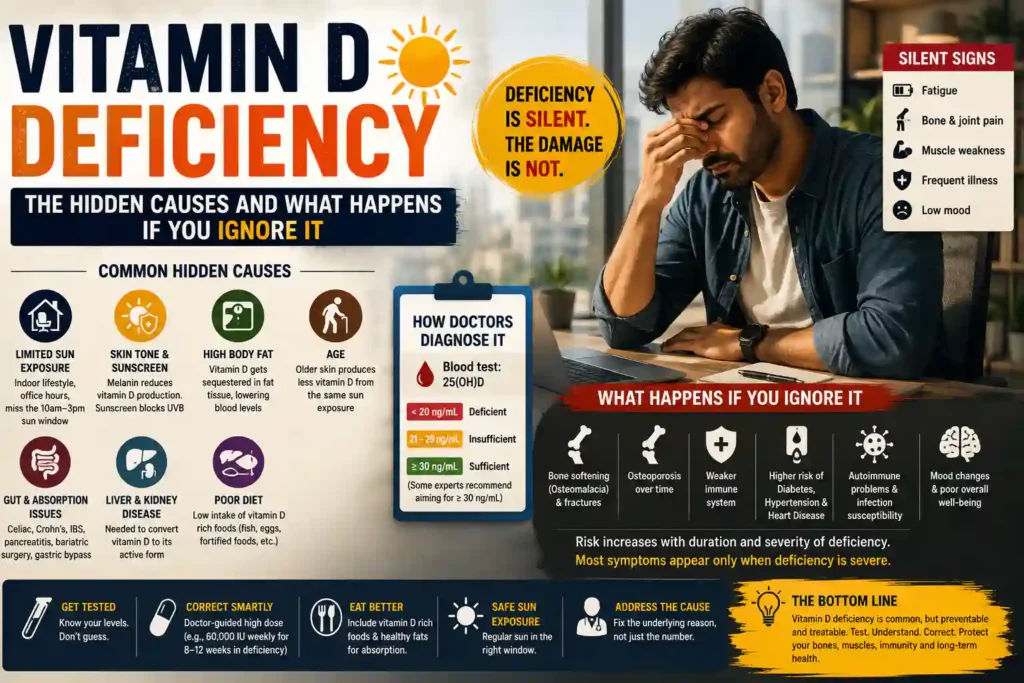
Body fat percentage plays a bigger role than most people realise. Vitamin D is fat-soluble, and research published by Cleveland Clinic notes that a body mass index above 30 is independently associated with lower circulating vitamin D, because fat tissue sequesters the vitamin and prevents it from being released into the bloodstream where it’s actually useful.
This means two people can get identical sun exposure and end up with very different blood test results depending on body composition.
Skin tone and melanin work against synthesis speed. Melanin functions as a natural sunscreen, so darker skin needs meaningfully more sun time to produce the same amount of vitamin D as lighter skin, which is directly relevant for most Indian skin tones.
Age slows the whole process down. Older skin has a reduced capacity to produce vitamin D from the same sun exposure that would be sufficient for a younger adult, which is part of why elderly populations show up disproportionately in Indian deficiency data.
Gut and organ conditions interfere with absorption regardless of intake. Conditions such as celiac disease, Crohn’s disease, chronic pancreatitis, cystic fibrosis and a history of bariatric or gastric bypass surgery can all prevent the intestines from properly absorbing vitamin D from food or supplements.
Kidney and liver disease create a separate problem entirely, since both organs are needed to convert raw vitamin D into its active form; a shortage of the enzymes they produce means even adequate intake never gets converted properly.
Everyday lifestyle factors round out the list: working indoor hours that don’t overlap with the 10 am to 3 pm UVB window, regular sunscreen use above SPF 7, clothing that covers most of the body, and diets that are low in the small number of naturally vitamin D-rich foods.
The practical point here is that if you’ve been in the sun regularly and your levels are still low, the answer usually isn’t “more sun.” It’s identifying which of these other factors might be working against you, which is a conversation worth having with a doctor rather than guessing.
How Deficiency Is Actually Diagnosed
A blood test measuring 25-hydroxyvitamin D, written as 25(OH)D on most lab reports, is the only reliable way to know where you stand. The commonly used thresholds are a level below 20 ng/mL counted as deficient, 21 to 29 ng/mL as insufficient, and 30 ng/mL and above as sufficient, though some specialists, including certain endocrine societies, argue for a higher target of 30 ng/mL as the true baseline rather than the floor.
What makes this test necessary rather than optional is that deficiency is, in the words of the Mayo Clinic’s own clinical guidance, typically silent until it becomes severe.
Most people carrying a genuine deficiency feel largely normal, or attribute the vague tiredness and aches to work stress or poor sleep, right up until the deficiency has been present long enough to cause a more obvious problem.
What Happens If It Goes Uncorrected
This is the part that tends to get skipped in casual health content, and it’s worth taking seriously.
Research reviewed through the US National Library of Medicine’s clinical reference resources draws a fairly clear line between short-term and long-term deficiency effects.
In the short term, low vitamin D shows up as bone and joint discomfort, muscle weakness, a weaker immune response and, in some studies, mood changes. These are unpleasant but generally reversible once levels are corrected.
Left uncorrected over months and years, the picture changes.
Chronic deficiency is directly linked to osteomalacia, a softening of the bone matrix that increases fracture risk, and over a longer horizon, osteoporosis.
A body of observational research, including reviews published through StatPearls and Merck’s clinical manuals, has also found associations between long-term deficiency and higher rates of type 2 diabetes, cardiovascular disease and hypertension, autoimmune conditions, and increased vulnerability to certain respiratory infections.
It’s worth being precise about the strength of this evidence: most of these links come from observational studies showing correlation, not randomised trials proving that low vitamin D directly causes these diseases.
Researchers are still working out how much of the relationship is cause and how much is that people with these conditions also tend to spend less time outdoors and have other overlapping risk factors.
But the association itself, across dozens of independent studies, is consistent enough that most clinicians treat prolonged deficiency as something worth correcting rather than monitoring indefinitely.
There’s also a two-way relationship worth knowing about, particularly relevant if you’re managing digestive or metabolic health already.
Research on inflammatory bowel disease patients has found that low vitamin D isn’t just a side effect of the condition. It’s associated with higher disease activity, poorer response to treatment, and a higher risk of complications, meaning the deficiency itself may be actively working against recovery, not just accompanying it.
Who Should Get Tested Without Waiting for Symptoms
Given how often deficiency stays silent, a handful of groups make more sense as candidates for proactive testing rather than waiting for a symptom to prompt one: adults above 60, anyone with a BMI above 30, people managing digestive conditions like celiac or Crohn’s, anyone who has had bariatric or gastric bypass surgery, people with limited sun exposure due to indoor work schedules, and those with existing kidney or liver disease.
If you fall into more than one of these categories at once, that’s a reasonable case for annual testing rather than an occasional one.
Correcting It Properly
Once deficiency is confirmed through a blood test, correction typically involves a defined high-dose phase, commonly 60,000 IU of vitamin D3 once a week for eight to twelve weeks in the Indian clinical context, followed by a lower ongoing maintenance dose.
This is a doctor-guided protocol with a start and end point, not a supplement you add to your routine indefinitely at your own discretion.
Whatever underlying cause applies to your case, whether it’s body composition, an absorption issue or simply an indoor lifestyle, is worth discussing at the same appointment, since fixing the number on a blood report without addressing why it dropped in the first place is how people end up back at square one a year later.
The Bottom Line
Vitamin D deficiency is rarely just a sunlight problem, even though that’s how it gets talked about most often. Body fat, skin tone, age, gut health, organ function and daily habits all stack together to determine your actual risk, and the only way to know where you stand is a blood test, not a guess based on how much time you spend outdoors.
Left alone for long enough, deficiency moves from a background nuisance to a genuine contributor to bone, metabolic and immune problems down the line. The fix isn’t complicated once you know your number and your likely cause, but skipping the testing step is where most people go wrong.
This article is for general information and does not replace medical advice. Please consult a doctor before starting any supplement, especially at doses above the standard RDA.
Sources referenced in this article:
- NCBI StatPearls, “Vitamin D Deficiency” — risk factors, diagnosis and complications
- Cleveland Clinic, “Vitamin D Deficiency: Causes, Symptoms & Treatment”
- Mayo Clinic News Network, “Left Untreated Over Time, Vitamin D Deficiency Can Lead to Serious Bone Disorders”
- Merck Manual Professional Edition, “Vitamin D Deficiency and Dependency”
- PMC/NCBI, “Vitamin D Deficiency & Childhood Obesity: A Tale of Two Epidemics”
- PMC/NCBI, “The Role of Vitamin D in Inflammatory Bowel Diseases”
- News-Medical, “Vitamin D and Type 2 Diabetes”
- PMC/NCBI, “Vitamin D deficiency is a risk factor for obesity and diabetes type 2 in women at late reproductive age”